The story
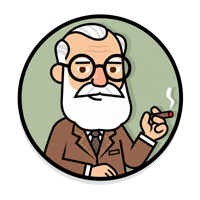
Psychiatry's documentation problem is not new. It is a hundred and thirty years old, and it started with the man this software is named after.
Vienna, 1886
By the end of the nineteenth century, medicine had noticed something it could not explain. The industrial age had rebuilt daily life — railways, factories, telegraphs, cities that doubled in a generation — and the waiting rooms filled with a new kind of patient. The American neurologist George Beard gave the condition a name, neurasthenia, and blamed it flatly on modern civilization: steam power, the periodical press, the telegraph, the pace of it all. In Munich, Emil Kraepelin was sorting the severe illnesses into the diagnostic categories psychiatry still descends from. In Paris, Jean-Martin Charcot was demonstrating that careful clinical observation could find order in symptoms other physicians dismissed.
Into that world came a young Viennese neurologist with a microscope and no money. Sigmund Freud had spent years at the bench — staining nerve cells, mapping the medulla, publishing a monograph on aphasia that stood for decades. He went to Paris to study under Charcot, came home, and opened a private practice, because a research career did not pay and he had a family to feed. A solo practice, seeing the patients the industrial city produced. That part of the story, every psychiatrist in private practice already knows from the inside.
Vienna, 1895
His colleague Josef Breuer told him about a patient, Anna O., who improved when she was allowed to talk her symptoms through to their origins. She named the method herself: the talking cure. Freud took that observation seriously enough to build a discipline on it. Studies on Hysteria appeared in 1895; the unconscious, transference, and the modern idea that a structured conversation can treat illness all grew from that work — and from it grew the entire family of psychotherapies that came after, through Jung and Rogers and Beck to the manualized, evidence-tested treatments in use today.
What gets forgotten is that Freud never stopped being a neurologist about it. The same year, he drafted his Project for a Scientific Psychology — an attempt to explain memory, attention, and judgment in terms of neurons and the energy moving between them. He abandoned it; the instruments were a century away. But he kept the ambition his whole life.
"All our provisional ideas in psychology will presumably some day be based on an organic substructure."Sigmund Freud, On Narcissism, 1914
He treated his own theories as scaffolding — the best available account, held honestly, until biology could do better. That is the posture of a scientist, and it is the posture this project inherits: clinical understanding, built to be checked against evidence, revised when the evidence says so.
Vienna, 1912
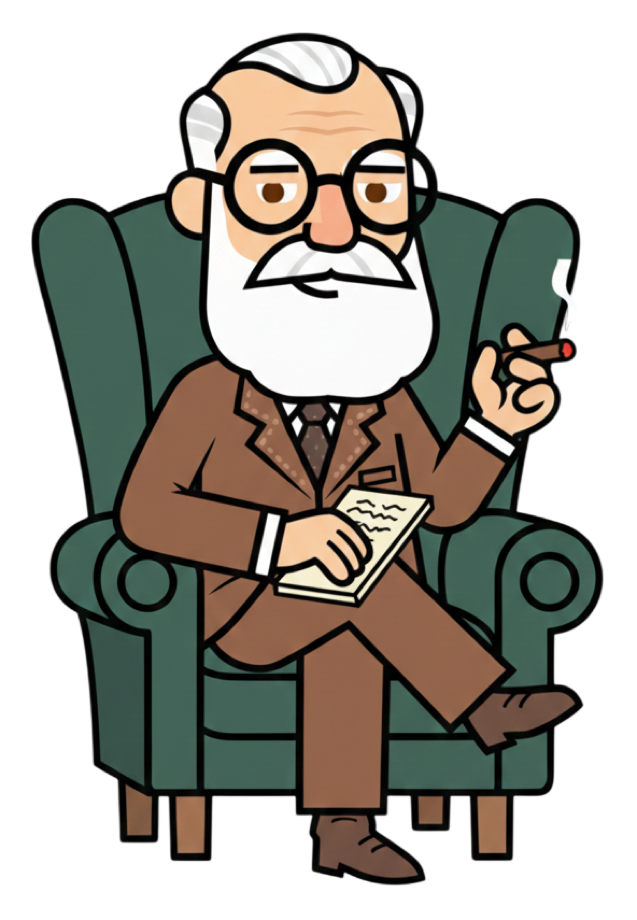
In 1912, Freud wrote down his technical advice for physicians learning his method. One recommendation stands out a century later. Do not take notes during the session, he said. Writing while the patient speaks splits the clinician in two — part listener, part stenographer — and the listening half misses what matters. He prescribed instead what he called evenly-suspended attention: the clinician's whole mind, turned toward the patient, selecting nothing, missing nothing.
Then he paid for it. Every evening, after the last patient left Berggasse 19, Freud sat down and reconstructed the day's sessions from memory. The surviving case records were written that way — at night, after hours, the day's clinical work done twice. He considered it the unavoidable cost of doing the work properly.
Sound familiar? It should. It is the same trade every psychiatrist makes today, except the terms have gotten worse. Freud wrote at night to preserve his attention for science. The modern clinician types during the session — into software built for a primary-care template — and still finishes notes at eleven p.m. for an insurance company. The screen took the attention anyway, and the evenings too.
"He should withhold all conscious influences from his capacity to attend, and give himself over completely to his 'unconscious memory.'"Sigmund Freud, Recommendations to Physicians Practising Psycho-Analysis, 1912
New York, now
Sigmund is built on a premise Freud stated and a hundred years of therapy research confirmed: the clinician's presence is itself an instrument of treatment. The alliance between a patient and a clinician who is actually listening predicts outcomes across every modality psychiatry uses — medication, therapy, and the combination that so often works best. Anything that pulls the clinician's attention toward a screen is taxing the treatment itself.
So Sigmund takes the stenography. It sits in on the visit, drafts the HPI, the mental status exam, the risk assessment, the scales, and the plan while you talk, runs a structured intake before the patient arrives, and handles the coding when you sign. The clinician keeps what Freud said the clinician must keep: evenly-suspended attention, the whole mind turned toward the patient.
The mission is the one Freud set and could never fully execute: understand mental illness well enough, patient by patient, that the understanding changes outcomes. He wanted the observation, the pattern, and the biology in one frame. He had a notebook and his evenings. A working psychiatric intelligence — one that documents rigorously, tracks symptoms over time, and brings the evidence to the moment of the decision — is what that ambition looks like with modern instruments. Sigmund exists to support clinicians in that work, visit after visit, and to get better at it the longer it works alongside them.
Where you come in
Freud ran a solo practice out of his apartment. Kraepelin ran a university clinic. The work adapts to the room it is in — and so does Sigmund.
No EHR, or just starting out
Intake, notes, symptom tracking, coding, and superbills in one place — a complete clinical workspace the day you see your first patient. No stack to assemble, nothing to migrate.
Already on an EHR
Your EHR holds the record; Sigmund does the psychiatric work on top of it — MSE, risk, scales, and evidence-cited plans, written back where API access is available. There is no migration project, because there is no migration.
Group practices & clinics
Every note in the practice arrives structured the same way — MSE present, risk documented, codes attached — whichever clinician wrote it. Request access to discuss a pilot alongside the systems you already run.
Sigmund is investigational and intended to assist — not replace — clinical judgment.